
Jun 1 2017, 3:00pm

The founding band member (and noted music critic) ranks the output from the long-running British pop act.
In Rank Your Records, we talk to artists who have amassed substantial discographies over the years and ask them to rate their releases in order of personal preference.
Bob Stanley is a songwriter and producer in Saint Etienne, one of England's greatest pop acts of the last quarter-century, but he's also a renowned author and music critic. He's had bylines in The Guardian, Mojo, NME, and Pitchfork, written liner notes for countless reissues, and in 2013 published Yeah! Yeah! Yeah!: The Story of Modern Pop, a deeply engrossing summary of the last 50 years in pop music. Without exaggeration, he is a national treasure along with the likes of Sir David Attenborough, Delia Derbyshire, Chris Morris, and Peppa Pig.
Being such a detailed music historian, Stanley seemed like a perfect fit to rank the records he's made with his mates Pete Wiggs and Sarah Cracknell as Saint Etienne. However, when I mention their new one, Home Counties, is the group's ninth so far, he stops me. "Wait, isn't it our tenth?" he says with a laugh. "I thought this was our tenth album. I need to stop saying that in interviews!" Considering their discography features a number of compilations, fan club-only exclusives, and countless singles, it's a forgivable mistake.
Like almost all of their previous albums, which would be eight, Home Counties follows their tradition of a particularly English theme. This time they chose to write about a day in the life of the area in which they grew up, what they call "this doughnut of shires that ring the capital." Says Stanley, "It's the suburbs and beyond, where people have to commute to London in order to get to work. It's quite conservative and not thought of as anywhere particularly creative, which is inspiring because the end result of growing up in a place like is us, Depeche Mode, the Rolling Stones, the Stranglers, acid house. We all came from Home Counties. Living there gives you something to kick against. People definitely think it's uncool to live there."
Noisey phoned up Stanley and got him to put his albums in order of favourite. He did such a good job we think he should turn it into his next book.
8. Foxbase Alpha (1991)

Bob Stanley: I think just because it's such a scrapbook of ideas. There's no real unity to it. There are songs on it that I like. I can understand why it could be a fan-favourite, because I think we sound enthusiastic. But I think we sound more enthusiastic than accomplished. Some songs I'm quite proud of, others have quite obvious and clunky samples. Things that other people like about it I likely find rather embarrassing.
"It did what we intended by not sounding remotely like what we saw as indie in 1991." How bad was indie music that year?
Well, there were a few things going on, and it felt like the most interesting stuff was being sidelined. There was this professional indie-ness that was starting to surface, whereas in the previous years, you had this Manchester thing, which was about taking the music to as many people as you can, much like the dance scene. This was people being curmudgeonly, like the Wonder Stuff going, "Who wants to be the disco king?" Why would anyone write a song like that? What kind of miserable life have you got where you want to write about people having being rubbish? Ned's Atomic Dustbin, they were another example. They were bloody awful. So there was the lot of that, stuff like Carter USM, people using terrible puns, and making records that sound very scratchy. They haven't dated well either. Not that many people are fond of them, unless they were 15 at the time and had this kind of residual liking for them. History has recorded them as dreadful. It was all very grey t-shirt. Not that we were the most glamorous people in the world. When you make pop records, you've got to dress up a little and spend time on your artwork.
The original idea for Saint Etienne was to have different vocalists sing covers. What changed?
It was only initially about singing covers because we hadn't written any songs of our own. But the reason why Sarah became a permanent singer was because we got on very well, her voice suited our music perfectly, and we had similar reference points. It just really clicked. Originally, we followed the Soul II Soul and Massive Attack models, where they had different singers on their records. Soul II Soul were kind of the blueprint, but then they started doing all of their songs with Caron Wheeler, so it made sense. If you find the singer you get on with, and her voice suits the music, you carry on with her. So it was as simple as that, and we're still best mates today!
7. Finisterre (2002)

Finisterre is now 15 years old, which is kind of the least optimum time to listen to a record, when I think about an old record. There's nothing wrong with it. A couple of songs could've been stronger. A song I wrote called "Action" was pointed out to me as sounding like a particular Beach Boys song, which I hadn't intended to do, and it does, so I was a little embarrassed by that. I won't say which, because I don't want to get sued. That was the first album we did quite a bit with Brian Higgins of Xenomania, which worked out really well. He's a very odd man, but also very talented. My favourite song is the title track, which we did with Ian Catt. We hadn't worked with Ian in quite some time, so that was nice.
This album was London-themed. The band said, "We all felt an urgency to breathe new life into London." What did you mean by that?
Wow, that's interesting. That's what we said? I dunno. That was a time when the Iraq war was happening, and there was a massive demonstration in London with two million people, which was the biggest demonstration ever in the country—and it still didn't do anything. So it felt like kicking back at something. Obviously, given the situation now and then, I'd swap it in a heartbeat, but it felt very disappointing that we got the Labour government for the first time in a half-century and they started out promising only to fizzle out quickly. And then lead us into a horrific war and unbalance the entire Middle East. Lyrically, I suppose it was about direct action. I suppose there was too much apathy in London, sort of as this hangover from Oasis and the Cool Britannia thing. Maybe that's what I meant. Again, 15 years is a weird gap because you can forget things or things don't fit together properly.
Finisterre was also a film, specifically about London.
Initially, the idea was to do a DVD that went with the album, where each song would have a video. Up to that point we'd done videos like everyone else, where it was slightly out of our hands and the budgets were relatively ludicrous and money you'd rather spend elsewhere. So we just said to the record company, "If you just give us 20 grand, we'll do videos for the whole album." Instead they gave us 20 grand to do the video for the first single and then said, "No, no, you can't do any more." Because we started doing this with Paul Kelly, it just became a film in its own right. The film came out a year after the album and I'm really proud of it. That stands up in its own right. It looks very of its time, because London has changed so much since then.
6. So Tough (1993)
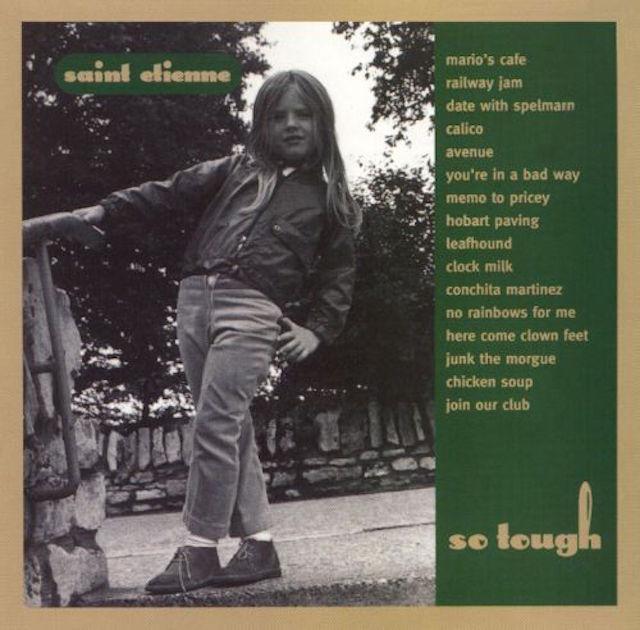
Again, this is me thinking about albums where I'd like to subtract a few songs and switch them with something else. Last time I listened to it, I felt it sounded a bit thin. One of the odd things about that was we went to clear the samples we put in between tracks, and it was almost impossible to clear any American samples. The only thing we could was Rush let us use the sample from "The Spirit of Radio." They were very kind and said, "We can't imagine why you'd want to ruin your very beautiful song with a horrible guitar sound." It was quite funny.
This was the first album you made with Sarah completely on board. How did that change things for you and Pete?
Me and Pete had a flat together at this point, so we came up with ideas at home in the studio, and then Sarah would bring her own ideas. We were probably less than generous on that album, and should have given Sarah more songs. She had a song called "Paper" that was a B-side; it was really nice and should have been on the album. The idea was to do what we did with Foxbase Alpha, just make it more complete by linking it through with film samples and bits of dialogue. The production with Ian Catt and our songwriting methods were pretty much the same. It was a top ten album at the time, which seems quite amazing now. And we had our first major hit, "You're In A Bad Way," which got us on Top of the Pops. That was obviously a big thrill.
What inspired you to link each song with dialogue from your favorite films?
Some of our favorite records, like the Monkees' Head soundtrack had bits of dialogue from the film, The Who Sell Out, which had fake ads and radio jingles, and a lot of hip-hop, especially the Daisy Age stuff like De La Soul.
What were some of the samples you couldn't clear?
I'm trying to think now. I do remember clearing the samples cost more than the album cost to record. Just because it was the period where people got wise to hip-hop samples in the States, and there were all of these huge legal cases going on. I think it cost about 30 grand just to clear the samples. Thinking back on it now, you'd think the record company would go, "Well, just don't use the samples!" It was a strange time.
5. Tiger Bay (1994)

Same thing really, maybe it wasn't quite as complete as it could have been. That was an odd one, because what normally happens when you finish a record is the label says, "We'll put it out in 18 months," and we're like, "What!?" But with this one, it was the other way around. We were about three-quarters of the way through it and then Creation said, probably because they were losing money hand over fist thanks to My Bloody Valentine's Loveless and had bands like Primal Scream in the studio. So it had to be rushed in the end, and to me that was my problem with it. There was a slight bit of antagonism in the group at the time, which is, I think, the only time that's ever happened. So that kind of sullies my memory a little. But, at the same time, I think the basic idea was to take traditional folk melodies and make an electronic album with them. On the whole, I think it worked out pretty well.
Were there many samples on this one?
Again, as I said, you react to the press you get, and we got some negative press saying we couldn't actually write any songs ourselves without relying on samples. So we decided to make an album that didn't have any samples at all. So that's what we did. Good Humor was the same.
You told Pitchfork, "We should have done something more commercial than Tiger Bay" and that "it could have done with a couple more pop songs."
That's something we could have done. I think that's what people expected. We just had a couple of sizeable hits, and people expected an all-out pop record. Maybe Words and Music was the record we should have done in 1994. [Laughs] A lot of the stuff we were listening to then would have been dance music and Europop, so it wouldn't have been strange for us to do that. Instead, I had this stupid idea of making an electronic folk album.
The original album cover with the painting was an interesting choice.
Yes, I remember after a Suede gig, Brett Anderson kept saying to me, "What's that album cover all about? What's that album cover all about?" Like I was completely insane and made a terrible mistake.
Well, in North America we had a different album cover. It wasn't the painting but a portrait of the band. Why was that?
In Europe, there was another version with a different sleeve and a different tracklisting. We were getting dropped by Warner Brothers at the time and I think they tried to do what they could with it and messed it about. That was nothing to do with us. They got a couple of awful remixes done in America as well. Can't remember the guy's name. He did a version of "Like A Motorway" that was just horrible. It didn't sound like us at all. They also suggested we change the title to "Like A Freeway." And we said, "No, we're not gonna do that. I can't believe you asked us to do that." But in spite of that, I know it's the favourite album for a lot of people, and some of the songs work really well.
4. Tales from Turnpike House (2005)

I can't remember where we got the idea from where all of the characters live in different flats in this block. But it was nice to write some character sketches after Finisterre. It was much lighter, as you can tell from the album cover. I love the artwork. Pete moved back to Croydon, which is our hometown.
Turnpike House is an actual place, correct?
Yes, it's where Paul Kelly used to live. To be honest, we just took the name. It was Pete's idea to borrow it. But it's not really about that block of flats. We were thinking it was a block of flats further out in suburban London. Turnpike House is in Islington. It looks a lot like the block of flats on the cover of the first Streets album.
To me this is your most under-appreciated album. It didn't get a very big push here in North America.
It came out over here on Sanctuary, who did an okay job. And in America it came out on Savoy, the jazz label, which was really bizarre. I'm not sure how that happened or if they thought it was a jazz record. Again, they messed around with the tracklisting in the States, which was strange because the running order is supposed to be 24 hours in the life of this block of flats. So it was quite important to keep the songs in order. [Laughs]
The album initially came with an EP of kids songs, Up The Wooden Hills . You began writing that, correct?
Ah, yes, that's true. I forgot about that! We did finish the kids album, it just never came out. There were a few other songs that were languishing, and we didn't use them as bonus tracks because we thought we'd finish it one day. What we wanted to do was release a hardboard book with a story about each song. We got quite a ways down the line, with Daniel Handler of Lemony Snicket doing it but we couldn't agree to terms with his agent. So it never came out, which was a real shame because instead we did nothing. His agent was Ally Sheedy's mum, which is quite impressive. [Laughs] So, yes, we did start out making a children's album, but then it turned into something completely different.
3. Sound of Water (2000)

We recorded it in Berlin. The thinking wasn't much beyond "doing a Berlin album." At the time, I was listening to a lot of electronica. What was happening in Britain was that bands like the Verve and Oasis had swallowed up indie and destroyed it. Pop music was interesting, like this post-Spice Girls scene of B*Witched, S Club 7, and Billie Piper, which was great bubblegum, but not something we could do without sounding like we were trying to be 15. So it kind of left us wondering, "What are we gonna do?" Plus, it was also coming out in the year 2000, so it felt like an important date. So we went to Berlin.
And you worked with To Rococo Rot.
We initially asked Kreidler, who were based in Dusseldorf. Stefan Schneider was in both groups, and he much more enthusiastic, but wanted to do it more as To Rococo Rot.
Were you into a lot of the post-rock stuff that was coming out of Berlin at the time?
Yeah, bits of it, and there was a lot of space rock going on at the same time. There was a lot of interesting non-pop stuff. I wasn't a big fan of Tortoise, because they were a bit too jazzy for me, but I liked Labradford. I was definitely more into the melodic stuff. A lot of the electronic stuff at the time was into glitch, and that really took away from melody. I liked Schneider TM and Boards of Canada, as well as little labels in the UK like Static Caravan and City Centre Offices, which is a brilliant name for a label. They put out these anonymous seven-inches I would get at Rough Trade and, quite often, they were terrific. We weren't really gonna compete with the pop acts, so we just decided to make a record that, well, probably no one was gonna buy! [Laughs] And our wish came true!
2. Words and Music by Saint Etienne (2012)

Like I said, it's probably the album we should have done in 1994 if we wanted to become rich and famous, but it's quite nice to do a straight-up pop record as we're all about to turn 50.
Why did it take so long to release a new full-length?
It didn't feel that long, I suppose, but it was such a long time, wasn't it? No real reason. Pete and Sarah both had kids. What the hell was I doing? I was writing, I suppose. We were making films and other work. We were artist in residence at Southbank, which was amazing. We did a bunch of fan club records, we just didn't do an album. It just didn't feel like seven years. That's all I can say. I was writing Yeah! Yeah! Yeah! when we started it, so it kind of made sense to write about the power of pop music, because that's what it was about.
How was writing an album about music different from writing the others?
It was maybe more difficult. I found it quite difficult to do the lyrics, because obviously I couldn't write them like a review or a book. They had to be lyrics, which is a completely different way of writing. I felt a bit self-conscious about that. As with Home Counties, once we got the theme for the album, all three of us started writing it fairly quickly. It's good to have a theme. We've all got slightly different writing styles, but they're similar enough that I don't think people can really tell who wrote what.
Also Xenomania had imploded, so the people there were all working independently. So we could record with them without feeling pressured. We also wrote with Rob Davis, who did Kylie's "Can't Get You Out Of My Head" and Spiller's "Groovejet." He was a lovely bloke. The whole thing was about being in love with pop music, which is why we worked with so many different producers.
1. Good Humor (1998)

Why is this your favorite?
We'd done the first three albums, and then took a little break. When we got back together, we got a flat together in Malmö, Sweden, for six weeks. We'd go out in the evening and play pool. It was a really happy time, which I think comes across in the music. Tore Johansson was a great producer to work with. He was like a wise, old professor, even though he's only probably two years older than me. [Laughs] As we've done with Home Counties, it was great to use old, analog equipment. Not just using a specific vintage guitar, but feeding something through a knackered old cassette recorder to see what it does to the sound. That's a lot of fun. It was nice to experiment and change sounds. It was very liberating. There are a lot of reasons why this is my favorite album. It was the most enjoyable up until that point, and I have very fond memories of it.
Sarah described your time in Sweden to "like being in the Monkees."
It really was. We were just three people sharing a flat and playing Jenga. It was very wholesome.
I like this album because it was the English band that went to Sweden to make an album about America.
[Laughs] I've no idea why all of the lyrics were about America. I don't remember talking about it, but it just ended up that way. And in a cartoonish kind of way. Recording the album in Sweden, to the Swedes, was the worst thing we could have done. We got terrible reviews. Up to that point, we were very popular in Sweden too. It's funny how different countries can react like that, but obviously it destroyed our career in Sweden!
It had the opposite impact on America, where it became your best-selling album.
It's quite funny. Maybe we should have changed the title to "Like A Freeway" earlier!
Is it true that Good Humor's release was delayed because Creation wanted to focus on Oasis' Be Here Now ?
Yeah, quite possibly. It was finished a year before it came out. And like I was saying with Tiger Bay, there was quite a delay with Good Humor. It felt like we, didn't miss the boat, but the by the time it came out Tore had done Gran Turismo with the Cardigans, which sold zillions of copies. It's one of those things where looking back it didn't seem like an important thing, but it was quite deflating. You finish the record and have to sit on it for a year. Meanwhile you have no idea what will happen to pop music in the time in between. Apart from that, the actual making of it was a lot of fun.
Cam Lindsay is on Twitter.
Original article is here


